Tuesday, October 15, 2013

Oct 7-11th, 2013 Sonlight Core F Week 3


Oct 7-11th, 2013  
Sonlight Core F  
Week 3

We had a good week and got some more things added back into our schedule.  We restarted our exercise dvd program with Leslie Sansone on the days we didn't have something scheduled.  She has a Swim & Gym class on Tuesday and a Gym class on Thursday; so she didn't need to workout on those days.

Dh celebrated his birthday during this week, so Dd had a lot of fun painting and cooking and working hard to make his birthday special with gifts made with lots of love and care.  I will try to get some photo's of her work....except the cake---I think it is too late to take a picture of that!!!

Bible--Veritas Press is really going very well!!!  It is really GREAT getting to really sink our brains into Genesis and not rush, rush through our bible reading for a change!!  I am really loving it!  We are completed Genesis Through Joshua- Card 11-Sodom & Gomorrah on Monday; and Tuesday through Friday we completed Card 12- Abraham & Isaac.

We finished Apologia's What I Believe- Who Is My Neighbor book-page 263-276.  This was a great book.  This was particularly appropriate to co-ordinate with Sonlight's Core E b/c they had a running story throughout the book of a family that had half of their family in the North and half of their family in the South.  The family voiced the thoughts, feelings, and concerns that were common during the Civil War and connected well with Core E.

AAS 5: Step 12-completed---but it was a hard lesson!
we had started Step 12 last week; and spent this whole week working on this lesson!


Product Details

The Grammar Ace: Student Workbook by Duane Bolin and Dave Lilly

The Grammar Ace: Lesson 17
IEW: Fix-It: Week 23 


Math U See: Zeta: 3 A-E


Apologia Zoology 1: Flying Creatures of the Fifth Day: pg 169-182


The Periodic Table of Elements http://www.periodicvideos.com/videos/074.htm
University of Nottingham--Periodic Table of Video's
Ir-Iridium
Video's: "Super Expensive Metals", "Gold Bullion Vault, Bank of England"


Product Details

The Mystery of the Periodic Table (Living History Library) by Benjamin D. Wiker, Jeanne Bendick and Theodore Schluenderfritz

The Mystery of the Periodic Table by Benjamin D. Wiker


Art:
"Bio" video on Georgia O'Keefe
Dd made a watercolor, a card, and a picture frame, and printed 2 photo's to go in the picture frame (exchangeable).


Baking:
She baked her Pappa a chocolate birthday cake!


SL Core F:
Our books coming along well!  Especially Where the Mountain Meets the Moon--we had to read ahead!!
Product Details

All the Small Poems and Fourteen More by Valerie Worth and Natalie Babbitt 


Product Details

Sing the Word - All Nations Shall Worship Steve Harrow by The Harrow Family


Product Details

Praying through the 100 Gateway Cities of the 10/40 Window by YWAM Publishing, C. Peter Wagner, Stephen Peters and Mark Wilson

The EHN pages are slow; and Dd didn't do it each day.  I think the shine and newness is wearing off.  


Fun Reader:
Product Details

Adopted Jane by Helen Fern Daringer and Kate Seredy


Adopted Jane by Helen F. Daringer - finished
Surf Drawing Classes--Update class 4 & 5

I have been updating my first post on the drawing class, which is located on Sept. 29th, 2013 but thought that perhaps someone might be interested to see the new material up-front too.  


Class Four: 10-10-13
We began with our prayer (we always do!) then I read the page I handed out on Georgia O'Keefe (I actually only read the high points since it was a little long and we didn't have time for every line.) and looked at the color print of the color print of Purple Petunia and discussed it.  Then we did our warm-up drawing exercises.  During our very first class I had the class answer a lot of questions regarding what we could do during the class; and one question was whether or not they would want to draw with paper taped up on the wall; and they had unanimously said "yes!".  Dd and I bought a big roll of brown butchers paper at Lowe's and some masking tape and put up 16 large pieces around the room for each student to have a station.  The students could use pencil, or black Sharpie, or black drawing pens.  They had a BLAST!!!!  So much so, that we are going to do it again this week. 

http://img.hsmagazine.net/2011/05/georgia-o-keefe-black-and-purple-petunias.jpg


Georgia O’Keefe
One of America’s most well known female artists was born on November 15, 1887 to Ida and Frank O’Keefe.  She was the eldest of five girls in a family of seven children.  Her father was a successful farmer in Wisconsin.  She grew up working on the farm; learning to sew, cook, tend the vegetable garden, building her own doll house and spending hours creating make-believe worlds.   Her mother thought all her children should go to college and learn a profession to work outside the home.
Georgia knew by the age of 10 that she was an artist.  She studied at the School of the Art Institute of Chicago from 1905-1906.  She attended the Art Students League in New York City under William Merritt Chase.  Chase had a tremendous influence on her.  He taught the “plen air” method of painting, and often taught his students in outdoor classes.  Chase said to be “artistic in every way”.  To him, the process of painting was more important than the final work.  He made his students paint eight or ten pictures one on top of the other until the canvas became too thick with paint.  He insisted that his students should paint a new picture every day and experiment with painting the same things in different ways.  These lessons I’ve just mentioned of Chase’s are very much lessons that O’Keefe took to use herself!  When studying O’Keefe, you can clearly see how influential Chase was to her foundation.
So, that is Georgia’s education---why is she so famous that we are talking about her?  Well, I think if we were to walk up to someone on the street and ask “Who is Georgia O’Keefe?” they would say something about her being the lady that paints enormous paintings of flowers; and they would be right.  No one had ever painted flowers this way before; and LOTS of people had been painting flowers for a very long time!!!!  She changed the way people looked at flowers, and the way they painted flowers.  She found her OWN way; her very own unique style.  But, first she started out doing the basics just like everyone else. Georgia won her first prize for a still-life of a rabbit in a class under Chase, and it looks so perfectly perfect…(and kind of boring too) but eventually she kept drawing (with charcoals mostly) and one thing lead to another and her work got attention in New York City in 1916 when she was 29 years old.  Alfred Stieglitz was a well known photographer and art gallery owner was so impressed with her drawings that he put her drawings up in his gallery….and the rest, they say, is history!  I only have one page to tell you about her, so I won’t go into all the details of Georgia and Steiglitz…but they fell in love and married; but most importantly, he encouraged her to focus on her artwork instead of teaching art (which is what she had been doing).  O’Keefe thought that the purpose of art is to show a thought or feeling, and that parts of a painting must work together in harmony.  She remained independent from shifting art trends and stayed true to her own vision, which was based on finding the essential, abstract forms in nature.
Last class we learned about Caravaggio, and how it seemed like he took a spotlight to his figures in his paintings—to force us to focus on what he wanted us to focus on…Well, O’Keefe doesn’t use a spotlight; she uses a MAGNIGFYING GLASS!  She makes us see her subject matter how she wants us to see it—her way!  I’ve found a few quotes from her—so she can tell you about herself!  I thought this might be better than me trying to do it.  Last facts first though: She painted and sculpted and worked all her life; making some two thousand pieces of art until she died at age 98!!!  She is easily considered one of America’s most famous artists.
“Nobody sees a flower, really, it is so small.  We haven’t the time-and to see takes time, like to have a friend takes time.”  “If I could paint the flower exactly as I see it no one would see what I see because I would paint it small.  So I said to myself- I’ll paint what I see- what the flower is to me, but I’ll paint it big, and they will be surprised into taking time to look at it-I will make even busy New Yorkers take time to see what I see of flowers.”
“I hate flowers- I paint them because they’re cheaper than models and they don’t move!”  “I found I could say things with color and shapes that I couldn’t say any other way-things I had no words for.”


This Week:


Class Five: 10-17-13


http://0.tqn.com/d/arthistory/1/0/o/2/1/Frida-Kahlo-Self-Portrait-with-Thorn-Necklace-and-Hummingbird-1940.jpg


Magdalena Carmen Frida Kahlo Calderon—a.k.a.-Frida Kahlo
Our painting is: Self-Portrait 1 – 1940 or Self-Portrait with Thorn Necklace & Hummingbird 16” x 24”
Was born in Coyoacan,  a small town on the outskirts of Mexico City, on July 6, 1907.  She died at the age of 47, on July 13, 1954.  In 1910 (she was 3 years old) the Mexico Revolution began and was a major influence throughout her life.  Her mother would usher her and her siblings back inside their home each time the revolutionary shots were fired in the streets where they lived.  To complicate her childhood further; she contracted polio at the age of six.  Polio left her right leg thinner than her left leg; so she wore paints or colorful, long skirts.  Finally, at age 18 she was in a major accident between the bus she was riding in and a trolley car.  Some of the riders died in the accident; Frida suffered many injuries: broken spinal column, broken collarbone, broken ribs, broken pelvis, eleven fractures in her right leg, a crushed and dislocated right foot, dislocated shoulder, iron handrail pierced her abdomen and her uterus which compromised her reproductive capacity.  She spent 3 months in a body cast; had 35 operations—mainly on her back, right leg, or right foot.  Understanding the extent of her injuries,  the amount of pain she was constantly in,  the amount of time she spent alone in hospitals or in bed is very critical to getting her perspective of her unique and painful life.  It was all this pain, and all this “brokenness” that caused her to become the artist that she became.  She needed a way to express herself and painting was a perfect outlet for her.
Unlike Georgia O’Keefe; Frida didn’t know as a child that she wanted to be an artist.  She doesn’t have thousands of paintings to her credit—or art school degrees.  She was a very curious child –always bringing home plants, rocks, insects, and small animals to study.  She was particularly bright and was admitted to the National Prepatory School of Mexico being one of only thirty-five girls admitted (quite an honor!).  Her father was a professional photographer and an amateur artist, who was curious about all kinds of things.  He taught her about photography; and this portal is how Frida’s paintings look----like photographs of herself!
What makes Frida so special?  **Frida painted her real feelings in a way that had never been seen before.**  Frida painted about  143 paintings; which 55 were self-portraits; it is the self-portraits that showed all the pain, agony, love, joy, sadness, loneliness, and passion she possessed.   Right after the accident, during her recovery time, Frida began painting while being laid up in her hospital bed.  She had to learn how to deal with being in pain and being bored.  She turned into one of the most popular Mexican artists of all time as a result; being the first Mexican artist to exhibit her own work at the Louvre Museum in Paris, France.  Like with Georgia O’Keefe; Frida was married to a famous artist, and I could spend my whole page talking about him-Diego Rivera (a cubist painter and muralist – one of Mexico’s most famous artists also); but I don’t have time.  They had a very rocky relationship with many up’s and down’s; which gave Frida fuel in which to paint more paintings about her love and devastation regarding Diego.
Now for some quotes from Frida for you to hear about her, from her:
“I paint self-portraits because I am so often alone, because I am the person I know best.”  
“My paintings carry with them the messages of pain.”  
“I never painted my dreams, I painted my own reality.”
 “Painting completes my life.”
I had huge sorrow (paraphrase mine)….”but it learned to swim and now I am overwhelmed by decency and proper behavior.” 
“Taking in one’s sorrow means risking that sorrow to eat you up from the inside.”
“They thought I was a Surrealist, but I wasn’t.  I never painted dreams.  I painted my own reality.”
“I am not sick.  I am broken.  But I am happy to be alive as long as I can paint.”
I hope you all are interested in learning more about Frida Kahlo and will learn more about her and her artwork!!

Saturday, October 5, 2013

Conner Prairie Interactive History Park Oct. 3, 2013

Conner Prairie History Park 
Oct. 3, 2013

In Process-----


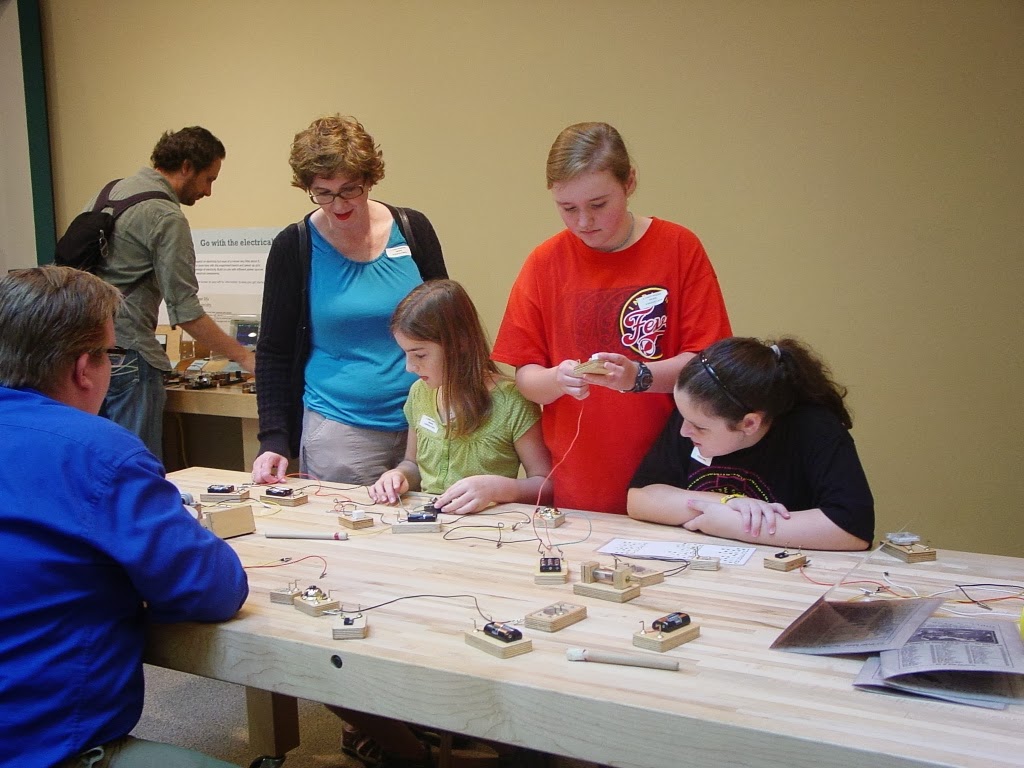
 We spent the first hour inside the Welcome Center doing science projects like these---electricity, building a windmill...etc. fun and educational.


This is a idea of the beautiful grounds...pasture lands and sheep, horses, pigs, cows, goats...


I took a few pictures of each of the FOUR HISTORIC PLACES WE VISITED:


Our first stop:


Lenape Indian Village:


1836 Prairietown:


This woman did the best job creating a real life scenario for us---it was as if we really walked back in time.  She was really making a great meal.  You can see the eggplant, egg, and flour on the table that she used to make the dish she is cooking on the fire.  She had some bread dough rising; and another bread already done on the table. 


Here she is teaching the young girls how to knead the dough properly.


This is another home (not the kitchen/cooking woman).  Here the woman was really knowledgeable and happy to share with us how to make "ink" from black walnuts---pick up walnuts off the ground; peel off the soft green shells; wait one year; crack the hard shells; then boil the hard shells in water for hours until you get the darkness and consistency you desire.

As we walked into her home she had a large wooden tray of 'sun-dried tomatoes'.  She shared with me how to do this process: cut up the tomatoes in thin slices; sprinkle with salt, and lay out in the hot sun for a week.

The white/tan jar with the wood/paper/and rock on top of it is her batch of vinegar she is making.   She told us the process for making vinegar--which she was doing in that jar--is to cut up apples and put them in water; and cover the top; and stir them one time a day; and continue this process for six or seven months--and you have vinegar!


This boy was using a stick to write with the walnut ink.


Conner Homestead:
 Indiana's first brick home where William Conner lived with his family from 1823 to 1837.


Here is the candle making place--we didn't make candles this time; but we have done it here before.  You dip your string in the black cauldron of wax, slowly, layer after layer as you build up a nice candle.


This is the schoolroom--the teacher walked out as we walked in...so we taught ourselves...just like at normal!!


1863: Civil War Experience: 
We Hoosiers volunteered to defend the state from Confederate General John Hunt  Morgan and his raiders.  This place was so fantastic--each building had interactive media presentations....hard to explain...but, it was as if we had just arrived the day after the Confederates had attacked this small town.  One store was still smoldering; and there were live characters interacting with us, telling us what happened "yesterday".  Again, hard to explain how cool this was....and how they had walls and windows turn into screens that would have people "talk to us".


See the soldier sitting on the chair?  He is a mannequins, and inside the closet was a movie that was activated by motion that was like the soldiers were talking to each other.  They had a lot of these set-up's between mannequins and interactive screens.


What a great day!


...

Friday, October 4, 2013

Sept 30th to Oct. 4th, 2013 Core F Week 2

Sept 30th to Oct. 4th, 2013
Core F
Week 2


This week we went to Conner Prairie!  It is a great place to visit; I only wish it were a bit closer so we could visit more often.  We had Swim & Gym on Tuesday and Dd is happier with the Lifeguarding instructor this time--even better than last time!  We also went to the library this week.

Overview this week:
Some general things we are focusing on this week-in the bible we are focusing on Lot and the story of Sodom & Gomorrah in Genesis 18 & 19.  In Sonlight we are studying CHINA (and will be for 2 more weeks).  In Language Arts, we are doing a big review of ADJECTIVES--and adding in Comparative Adj. and Superlative Adj.  In Science, we are continuing to focus on the Periodic Table of Elements plus in our Apologia book we focused on Life Cycles, then on the social insects, Ants.  We still don't have all our subjects added back in from taking our time off; but are slowly adding things back in.  This week we added Rosetta Stone, Typing Instructor, and Roots of English (a Latin/Greek program) back in. 
Bible: Veritas Press's Genesis Through Joshua is going really well for us.  I am really enjoying getting to focus on it and to keep moving forward.  I'm really glad we stopped doing it during Core E so we could really give it our undivided attention now. 

http://www.rainbowresource.com/products/vbgjcd.jpg  
The books we used along with program are:
Product Details

Believer's Bible Commentary   [BELIEVERS BIBLE COMMENTARY -SS] [Hardcover] by W.(Author) ; MacDonald, William(Author); Farstad, Arthur L.

Product Details

The Greenleaf Guide To Old Testament History by Rob G. Shearer and Cyndy A. Shearer

Product Details

David C. Cook Journey through the Bible by V. Gilbert Beers


  Matching Bibles, so we can read along side-by-side!

Product Details

The Inspirational Study Bible NKJV by Max Lucado


Product Details

The Inspirational Study Bible NKJV by Max Lucado


Memory Card 10: Hagar & Ishmael (Genesis 16-21) completed
Memory Card 11: Sodom & Gomorrah (Genesis 18-19) in process


Math:
Math U See: Zeta: Lesson 2A, B, C, D, E
Skip Counting Family: 4


Language Arts:
AAS 5: Step 11 passed, Step 12--in process
First Language Lessons: Lesson 77-79

Product Details

Roots of English by Paul O'Brien

 Roots of English: pg 23-25
Product Details

READING 2007 GRAMMAR AND WRITING PRACTICE BOOK GRADE 4 by Scott Foresman


Grammar and Writing Practice Book (Adjectives): 81,82,85
Hairy, Scary, Ordinary: What is an Adjective by Brian P. Cleary


We are studying CHINA!
Read Aloud:
When the Mountain Meets the Moon-FINISHED!
This book was so great; we couldn't put it down!  Minli learned that by putting others first, she got her wishes answered.  She met a young boy who had nothing, but a water buffalo and yet was so happy and content he wouldn't even accept any money from her.  He didn't even have living parents anymore; and he was sharing and giving her support and encouragement---and she did have parents, and her home was much better than his poor dirt floor room.  She learned so many lessons of how to be THANKFUL for what she had through her travels with dragon. 
 
 She returned home to Ba and Ma with a changed attitude.  The time without Minli actually helped Ma to learn to be more content with her life too.  Ma learned that her discontentedness had caused Minli to run away from home.  So both Ma and Minli really learned how to be thankful!
God's Adventurer: Hudson Taylor--finished


Reader 2:
 Adopted Jane--in process
Product Details

Adopted Jane by Helen Fern Daringer and Kate Seredy

  Amazon says: Jane Douglas has lived at an orphanage for long as she can remember. Reliable and sensible, she has watched other children come and go, but never once has any family wanted to adopt Jane. Then one magical summer Jane receives not one, but two, invitations to live in a real house with a real family for a month each. If only the summer could last forever. 


Rosetta Stone-French--1x (goal was 3x)

Typing Instructor--1x (goal was 2x)


China Study:

World Book & Eastern Hemisphere Notebook Pages:

 This is something that Dd works on for 30-60 minutes each day, researching different aspects about China each day...but hard to break down here. 


Science:

http://www.periodicvideos.com/

http://www.youtube.com/periodicvideos

The University of Nottingham is still warming our hearts and brains!!!  The crazy white haired professor Martin Poliakoff is so great! This week we were looking at:

Hf Hafnium 

Lv Livermorium

W Tungsten
Ta Tantalum
Video's: "Useful Diamonds", "The Mark of a Chemist", "About our Project", "Morphine & Heroin",  "Contains Loud Bangs (detonation & deflagration)", "Musket Firing" and another video - I didn't catch the name of it--about how and when each of the scientists found chemistry and the details around it....very interesting; and most of them were children at the time. 


You all know a new element was discovered a few weeks ago, right?!  Here it is talked about:

Element 115

Here is the info about the NEW ELEMENT: ELEMENT 115!!

http://www.periodicvideos.com/videos/115.htm


Product Details

Exploring Creation with Zoology 1: Flying Creatures of the Fifth Day -- Young Explorers Series (Young Explorer... by Jeannie Fulbright

Apologia: Zoology 1: Flying Creatures of the Fifth Day: pg. 152-169
Lesson 10: Insect Life Cycles & Life Styles

Lesson 11: Social Insects: Ants

Product Details

The Mystery of the Periodic Table (Living History Library) by Benjamin D. Wiker, Jeanne Bendick and Theodore Schluenderfritz


 The Mystery of the Periodic Table by Benjamin Walker
Chapter 1,2,3,4


Amazon says: Leads the reader on a delightful and absorbing journey through the ages, on the trail of the elements of the Periodic Table as we know them today. He introduces the young reader to people like Von Helmont, Boyle, Stahl, Priestly, Cavendish, Lavoisier, and many others, all incredibly diverse in personality and approach, who have laid the groundwork for a search that is still unfolding to this day. The first part of Wiker's witty and solidly instructive presentation is most suitable to middle school age, while the later chapters are designed for ages 12-13 and up, with a final chapter somewhat more advanced.


.